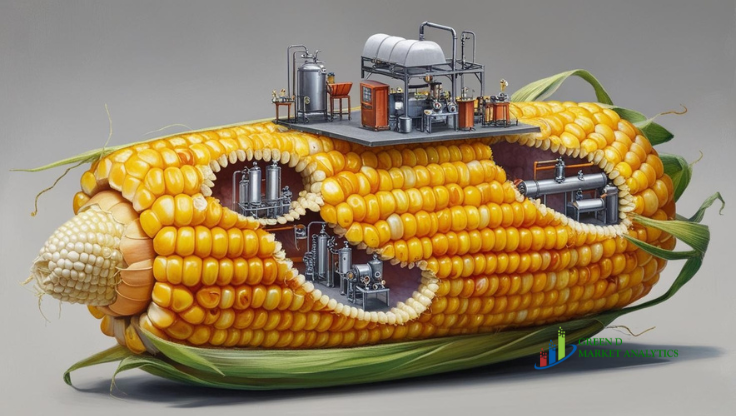

Biomanufacturing is moving deeper into China’s industrial policy base as indicated in the country’s recently-released 15th Five-Year Plan. The national 2026-2030 plan identifies biomanufacturing and advanced materials as priority areas for technological breakthroughs and industrial upgrading. China’s Ministry of Industry and Information Technology (MIIT) is also expected to issue a dedicated 15th Five-Year Biomanufacturing Development Plan, with public reports pointing to landmark products, AI application cases, pilot platforms, and high-performance bioreactors as key areas of focus. The plan aims to transform China’s biotech industry from R&D into a dominant global producer through enhanced manufacturing capabilities. Key focus industries will include biopharmaceuticals, food additives, bio-based materials, and new proteins.
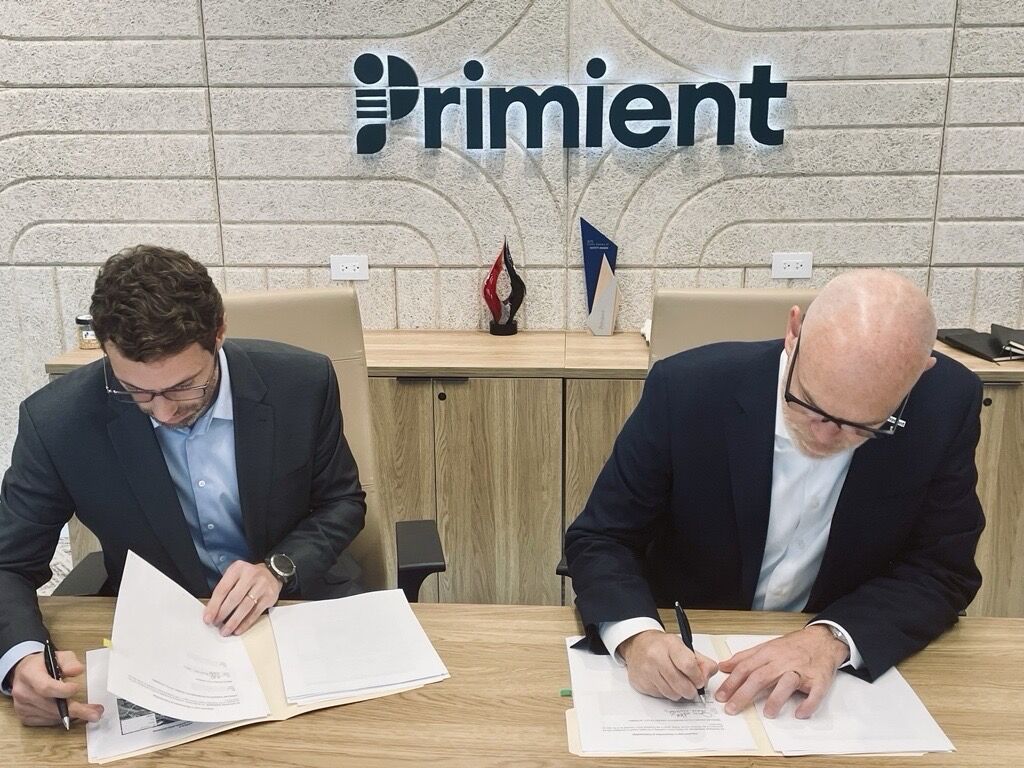
What is interesting is how China is becoming a commercialization venue not only for domestic technologies, but also for Western-origin low-carbon and biomanufacturing platforms. UK-based Econic and Changhua Chemical recently announced commercial production of CO2-based polycarbonate ether polyols in Lianyungang, Jiangsu, with around 80,000 tonnes of output planned for 2026. Argus reported in January that Switzerland-based Vioneo decided to shift its planned methanol-to-polymers project from Europe to China, pointing to green methanol access, better pricing, and a faster path to market. Last year, Eastman partnered with Huafon Chemical to build a domestic cellulose acetate yarn manufacturing facility in China. Huafon Chemical’s parent company, Huafon Group, acquired the DuPont Biomaterials business in 2022, which was rebranded as Covation Biomaterials. LanzaTech’s CO2-based ethanol licensees are already operating four commercial-scale waste-gas ethanol plants in China, supported by a Shanghai office and strategic investors in China including Sinopec.
A December 2025 article from World Bio Market Insights cited several major investment examples by existing Chinese chemical companies in the biomanufacturing space including Sinopec, Kingfa and Wanhua. China is now providing optimum location for faster scale-up and commercial deployment of bio-based/biodegradable polymers, bio-based chemical intermediates, and renewable hydrocarbon feedstock.
Green D Market Analytics’ GreenDMA Portal (subscription required) has mapped Chinese plants and projects covering 25 bio-based chemical intermediates and biopolymers across the 2021-2031 period, tracking capacity, location, technology route, project stage, and commercialization status. That type of analysis is an important strategic tool for companies assessing the broader competitive landscape between fossil-based and renewable chemicals, especially in sectors where feedstock economics, policy support, import substitution, and downstream demand can quickly shift the supply picture. In China, a new bio-based platform chemical project can alter the outlook for adjacent fossil-based intermediates, derivatives, and polymer chains, and vice versa.
It helps companies identify threats, partnership opportunities, feedstock risks, downstream openings, and the parts of the value chain where China may gain an early manufacturing advantage. For the renewable chemicals industry, the question is no longer whether China will be part of the next wave of biomanufacturing. The question is how much of that wave will be commercialized there first.
For this month’s update, here are our latest curated news and analysis, some of which are featured in the GreenDMA Portal:
- BUTANOL: Funding achieved for a bio-butanol project.
- DIACIDS: Middle East situation raises supply chain disruption risks for certain bio-based diacids.
- DIOLS: Environmental risk approval for a new bio-based PDO project in China.
- ETHYLENE: L’Oreal delves into CO2-based ethylene development for packaging materials.
- FURANICS: New patents on furan-based plasticizers, surfactant and polyester. China approves PEF as a new food-contact material. A 5-HMF project is on schedule for 2026 deployment. Chinese producer launches new PEF fiber.
- GLYCOLS: Bio-based MPG price moved up following price increases on fossil-based MPG.
- METHANOL: Approximately 60-70% of China’s methanol imports and around 25% of the global merchant methanol market are sourced from behind the Strait of Hormuz.
- PBAT: Price hikes in China in response to tightening fossil-based intermediates supply.
- PLA: A new consortium established for PLA production using food waste feedstock.
- POLYOLEFINS: Off-take agreement sealed for bio-based polyolefins supply.
- POLYOLS: Deployment of CO2-based polyols manufacturing in China. Deployment of mass balance-derived polyols in North America and Europe.
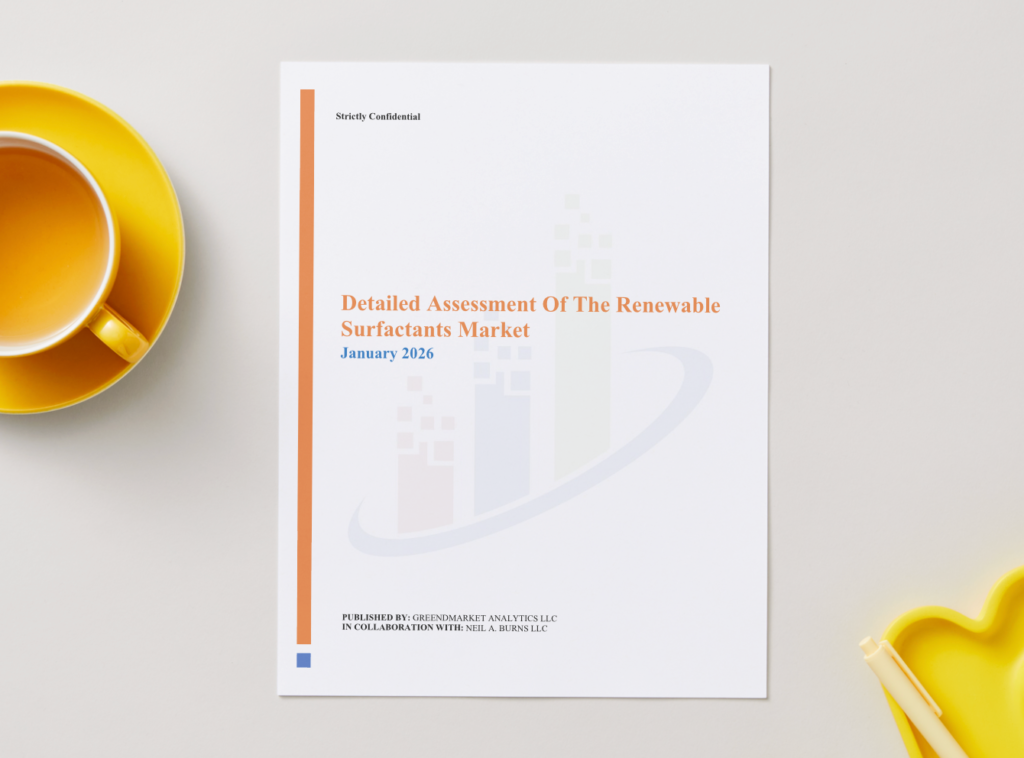
Green D Market Analytics’ new 243-page report, “Detailed Assessment of the Renewable Surfactants Market” is now available for purchase. Contact us at admin@greendma.com for more information.
The GreenDMA Portal is unique in its ability to provide current data on the renewable chemicals market, including Capacity, Product Profiles, Market Players, Market Share, New Investments, New Plants, Critical Industry News, and analyses. Find out more at greendma.com/portal.
Green D Market Analytics can provide a specialized report highlighting the market for bio-based chemical intermediates and monomers. We provide our clients with confidential reports on the current industry landscape, including new and planned projects. Please contact us at info@greendma.com for more information about our customized client services, detailed market data, and special reports.