
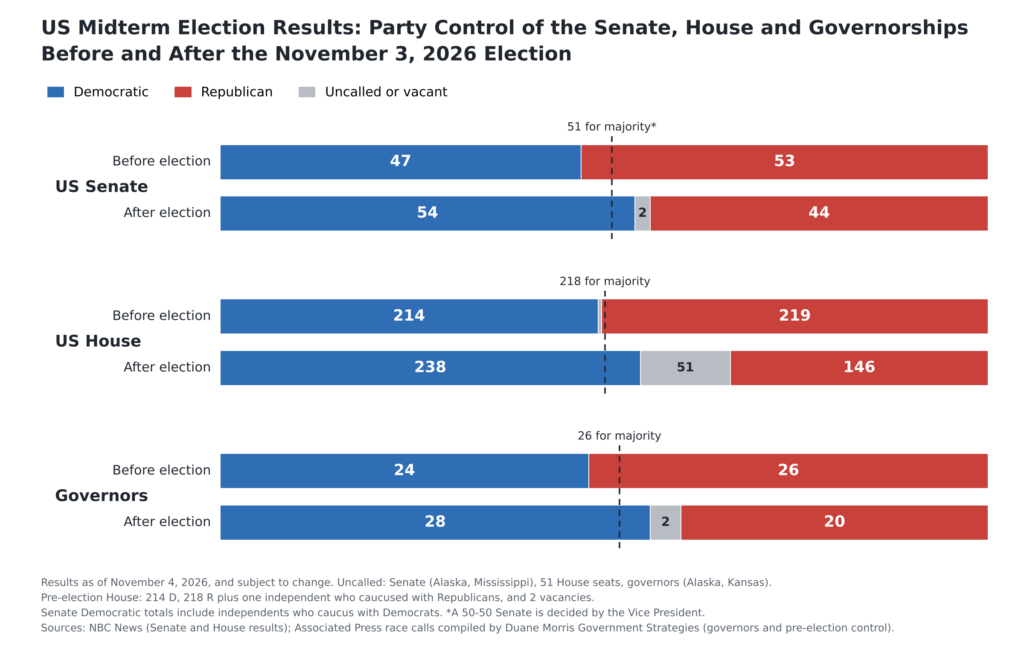
The November 3 USA midterm elections will give Democrats control of both chambers of Congress beginning in January 2027. As of November 4, Democrats had secured at least 54 Senate seats, including two independents who caucus with them, and a majority in the House, with several races still uncalled. Democrats also gained governorships in major agricultural and chemical-manufacturing states, including Iowa, Ohio, Texas and Georgia. The results could create new opportunities for renewable chemicals and biomanufacturing investments, although President Trump retains his veto authority and significant legislation will require bipartisan cooperation. State-level policy changes could also affect industrial incentives, agricultural feedstock utilization and manufacturing development.
One of the most important opportunities is the introduction of production and investment tax credits specifically for bio-based chemicals. The bipartisan Renewable Chemicals Act (S. 3632), sponsored by Senators Pete Ricketts and Chris Coons, proposes a production credit equivalent to 15% of the sales price or a 30% investment credit for qualifying renewable chemical facilities, subject to a minimum 95% bio-based content requirement. The House’s Biobased Materials Investment and Production Act (H.R. 8137) proposes a $0.10/lb production credit capped at $10 million annually or a 30% investment credit. Neither has become law, and both would need to be reintroduced if they fail to pass before the current Congress ends. The reelection of key Republican sponsors, together with Democrat Sherrod Brown’s return to the Senate, could help maintain bipartisan interest in these incentives.
The upcoming Farm Bill negotiations will provide an early test of whether the political shift translates into financial support for the bioeconomy. The House passed its Farm Bill in April 2026 by a 224–200 vote, while the Senate Agriculture Committee advanced its version in September by a party-line 12–11 vote. Final passage could slip into 2027 under new congressional leadership. Important provisions to monitor include the USDA’s Section 9003 biorefinery financing program and the BioPreferred Program, which supports federal procurement of biobased products. The election also creates opportunities to reconsider federal biomanufacturing priorities. As noted in a November 4 World Bio Market Insights article, the Trump administration has increasingly directed biotechnology support toward defense, national security and domestic resource independence rather than broader industrial decarbonization. The article highlights BioMADE’s $21 million investment in 14 biomanufacturing initiatives announced in April 2026 and its expanding pilot-plant network, while pointing to continuing gaps in commercialization support for emerging biomaterials.
International trade relations could become another important factor for renewable chemical producers and investors. Democratic control of Congress could increase scrutiny of the Trump administration’s tariffs, although the president retains substantial trade authority. The ongoing review of the United States-Mexico-Canada Agreement (USMCA), which was not renewed in its current form in July 2026 but remains in force, is particularly relevant to North American chemical and agricultural supply chains. Meanwhile, U.S. trade investigations into manufacturing overcapacity, including chemicals and plastics, highlight continuing concerns about competition from China and other Asian economies. Import restrictions could provide some protection for domestic bio-based chemical production but could also raise costs for imported intermediates, catalysts, processing equipment and other manufacturing inputs. Trade uncertainty may encourage regionalized supply chains without necessarily improving production economics or export competitiveness.
Despite the political changes, existing market fundamentals will remain important determinants of investment. The record 2026–2027 Renewable Fuel Standard volumes and Section 45Z clean fuel production credit, extended through 2029, continue to support renewable fuels, which compete with chemical producers for certain agricultural and waste-derived feedstocks. Proposed renewable chemical tax credits could help narrow the cost differential with fossil-based alternatives and support commercialization of renewable chemicals and materials. However, high capital requirements, petrochemical price competition, Chinese production overcapacity and limited long-term offtake commitments remain significant barriers. Investments based on domestic feedstocks and existing manufacturing infrastructure could be particularly relevant if additional incentives become available.
Green D Market Analytics expects the election results to create additional policy and investment opportunities during 2027–2028, but an immediate increase in renewable chemical production is unlikely. Greater access to federal financing, state manufacturing incentives and potentially more constructive international trade negotiations could encourage project development. The key developments to monitor include the Farm Bill, the possible reintroduction of renewable chemical tax incentives, federal biomanufacturing appropriations, trade negotiations and actual project financing commitments. Political support alone does not guarantee commercial competitiveness, and the election outcome does not yet justify upward revisions to near-term renewable chemical capacity or production forecasts.
Green D Market Analytics helps companies assess these developments and navigate evolving renewable chemicals and bio-based materials markets through custom consulting, multi-client market reports and the GreenDMA database portal. Our coverage includes policy and trade developments, affected chemical value chains, supplier activities, technology commercialization, pricing trends, capacity expansion and investment opportunities. Which policies could stimulate demand or alter manufacturing costs? Which renewable chemicals face greater competitive or trade risks? Where are companies scaling production, and how are global supply chains changing? GreenDMA provides independent, data-driven market intelligence to help companies evaluate these developments and make informed business decisions, supported by ongoing industry news, market analysis and project updates.
For this month’s update, here are our latest curated news and analysis, some of which are featured in the GreenDMA Portal:
- AROMATICS: Michelin’s DragonFly takes bio-based aromatics monomer to industrial scale.
- DIACIDS: A Chinese company strengthens position in the sebacic acid market with expanded fermentation-based capacity.
- DIAMINES: Europe recognizes lysine as strategic chemical.
- DIOLS: A Chinese company advances bio-BDO commercialization and expands downstream bio-based polyester portfolio. The future of a major Chinese bio-PDO producer in limbo while the rest of China’s bio-based PDO expansion advances.
- EPOXIES: An Asian bio-based epichlorohydrin producer to build an epoxy resin facility.
- FURANICS: China’s bio-based polyethylene furanoate industry is gathering momentum.
- GLYCOLS: UPM officially inaugurated its €1.37 billion biorefinery in Leuna, Germany. Bio-based glycols global output estimated at just ~40 ktpa in 2025.
- HYDROCARBONS: C1 Green Chemicals secures €13.3 million EU grant to advance renewable methanol.
- PHA and PLA: NatureWorks expands PLA’s reach into high-performance paperboard packaging. New PHA Applications in adhesives, consumer goods and specialty materials. A lactic acid plant in Asia nears commercialization stage. Lactic acid and PLA utilization is up in China. A European biotech company advances 10 ktpa PHBV project.
- POLYURETHANE: CovationBio and INSITE expand bio-based polyurethane footwear collaboration.
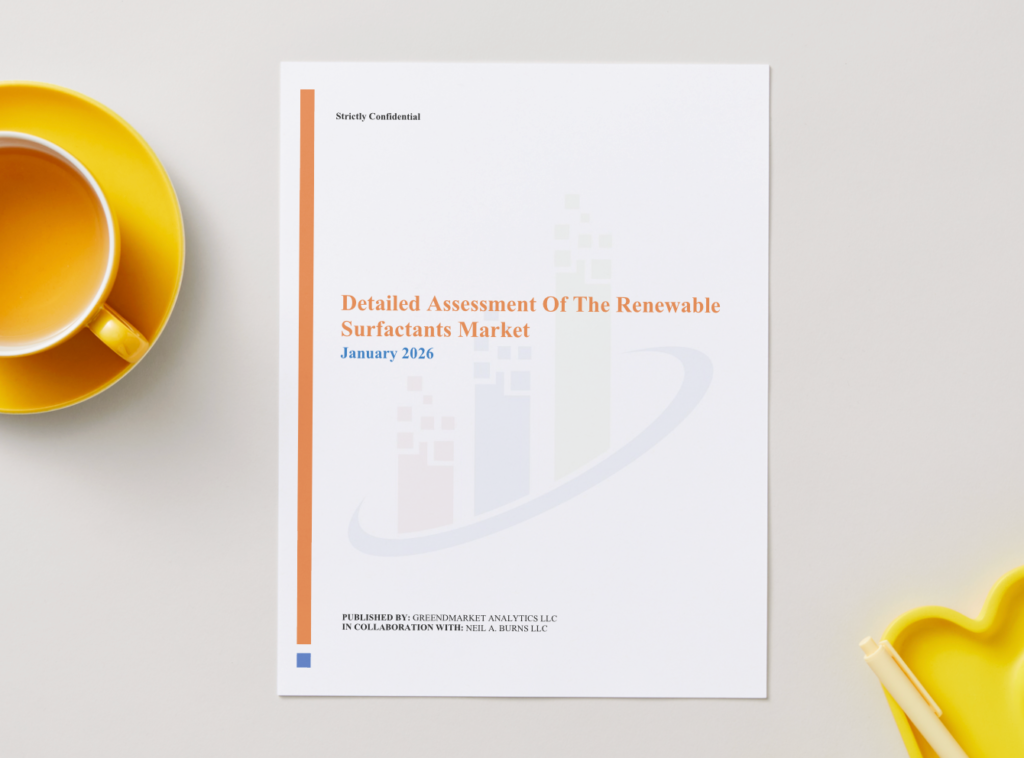
Green D Market Analytics’ new 243-page report, “Detailed Assessment of the Renewable Surfactants Market” is now available for purchase.
Contact us at admin@greendma.com for more information.
Green D Market Analytics can provide a specialized report highlighting the market for bio-based chemical intermediates and monomers. We provide our clients with confidential reports on the current industry landscape, including new and planned projects. Please contact us at info@greendma.com for more information about our customized client services, detailed market data, and special reports.
The GreenDMA Portal is unique in its ability to provide current data on the renewable chemicals market, including Capacity, Product Profiles, Market Players, Market Share, New Investments, New Plants, Critical Industry News, and analyses. Find out more at greendma.com/portal.

Leave a Reply