
EU textile and footwear rules are now entering their implementation phase, with new obligations covering unsold goods, textile waste collection, producer responsibility, waste exports and environmental claims. Large companies will be banned from destroying unsold apparel, clothing accessories and footwear placed on the EU market from 19 July 2026 under the Ecodesign for Sustainable Products Regulation, with medium-sized companies expected to follow in 2030. The revised Waste Framework Directive, in force since 16 October 2025, sets the basis for textile and footwear EPR schemes and new rules on used textile and textile waste management. The Waste Shipment Regulation tightens waste export controls, while the Empowering Consumers for the Green Transition Directive targets vague or unsupported environmental claims. Footwear supply chains also face wider sourcing rules, including the EU Forced Labour Regulation from 14 December 2027 and the EU Deforestation Regulation for covered commodities such as rubber.
The pressure point is no longer just lower carbon content for chemical suppliers with these new policies. Brands will need more information on fibers, dyes, pigments, coatings, additives, elastane, adhesives, leather chemicals and finishing agents that affect durability, recyclability, sorting, waste classification and product claims. Brands will also have to document more of what goes into their products and avoid materials that make reuse, sorting or recycling harder. Chemical demand linked to low-cost virgin textile volume could face pressure where brands reduce overproduction or redirect unsold stock into resale, repair, reuse or recycling. On the other side, the rules create demand for decolorization, dye stripping, depolymerization, solvent-based recycling, enzymatic recycling, odor-control, cleaning, repair adhesives, recyclable coatings, bio-based polymers and traceability systems.
Color, finishing and fabric developers are already moving around this regulatory implementations. Octarine Bio raised new funding in 2026 to scale production of its PurePalette™ precision-fermented colors, including PurePurple, PureGreen and PureBlue, for applications including textiles. Sparxell raised €4.2 million to scale plant-based structural color technology, with ton-scale production facilities expected to be operational in 2026. BRUGNOLI GIOVANNI S.P.A. developed its Br4/E1 technical stretch fabric with up to 89% bio-based content, using bio-based polyamide and renewable LYCRA fiber. In leather alternatives, Modern Meadow and HELLER-LEDER launched INNOVERA™ Europe for European production of next-generation materials, while MycoWorks was acquired by DFX Corp as it restructures around Fine Mycelium™ commercialization. The EU-funded Fabulose Project is developing animal-free leather alternatives from bacterial cellulose and cyanophycin. Kraig Biocraft Laboratories, Inc. is also pushing recombinant spider silk scale-up, targeting 10 metric tons/month of recombinant spider silk cocoon output and reporting deployment of more than 700,000 BAM-1 Alpha production hybrids.
Fiber and polymer suppliers are moving in the same direction. Rubi Laboratories is working with H&M and other partners on an enzymatic route that uses captured CO₂ to produce cellulose for lyocell or viscose. GS Biomats launched its FURIX™ furan-based polymer platform, including PEF fiber applications in staple fiber, wool top and filament forms. Neste, Goldwin, Idemitsu Kosan Co.,Ltd. and Toray Industries, Inc. established a renewable nylon fiber supply chain using Neste RE™, with selected The North Face products scheduled to use the material from August 2026. Cathay Biotech Inc. is supporting China’s new bio-based PA56 dipped cord fabric industry standard, which took effect on 1st November 2025. In Germany, the bioPEtex project is developing 100% bio-based PE fibers for textile applications. BASF and Lindex are bringing BASF’s loopamid® textile-to-textile recycled PA6 into lingerie, with first products planned for early 2027. Syntetica and Michelin’s Center for Sustainable Materials are also working to scale chemical recycling of nylon-rich mixed textiles without pre-sorting.
Green D Market Analytics can support companies tracking these policy changes through our custom market reports and GreenDMA database portal. Coverage includes affected chemical value chains, supplier activities, renewable material developments, technology scale-up, pricing signals, capacity build-out and commercial readiness. Which policies are changing demand? Which materials and chemicals face risk? Which technologies and companies are scaling, and where are new supply-chain opportunities forming? Green D Market Analytics can help provide answers to these questions. The GreenDMA Portal also provides ongoing news and market updates for products and companies that need regular tracking rather than one-off search.
For this month’s update, here are our latest curated news and analysis, some of which are featured in the GreenDMA Portal:
- ACRYLIC ACID: NOROO Holdings Advances Commercialization of Bio-Based 3-HP Through Major Korean Government Initiative
- BUTANOL: Catalyxx has secured €20 million in EU funding.
- CARBOXYLIC ACIDS: AFYREN ramps up acids production in the first months of 2026. Krahn Chemie Polska & GF Biochemicals collaborate on levulinic acid-based formulations in HI&I, Personal Care and CASE segments. Itaconic acid in crop production field trials.
- DIOLS: Tate & Lyle acquisition by Ingredion Incorporated.
- ETHYLENE: Beijing Shougang LanzaTech Technology Co. listed on the Hong Kong Stock Exchange. Celanese and Siegwerk Collaborate to Advance More Sustainable Printing Ink Solutions.
- FURANICS: Avantium collaborates with Gepack and Frubaça on small PEF bottles for functional beverage shots.
- PINE CHEMICALS: Kraton produces pine-based, bio-based rosin ester tackifier.
- PHA and PLA: ECOPHA Files PCT Patent for Pongamia Oil Co-Production Platform. BluePHA delays its 25 ktpa PHA project. TotalEnergies Corbion highlights its Luminy PLA Sustainability. Bambu Lab Launches PLA Filament for 3DPrinting.
- POLYOLS: Econic Technologies Introduces Polyols for Polyurethane Dispersions Made from Captured Carbon.
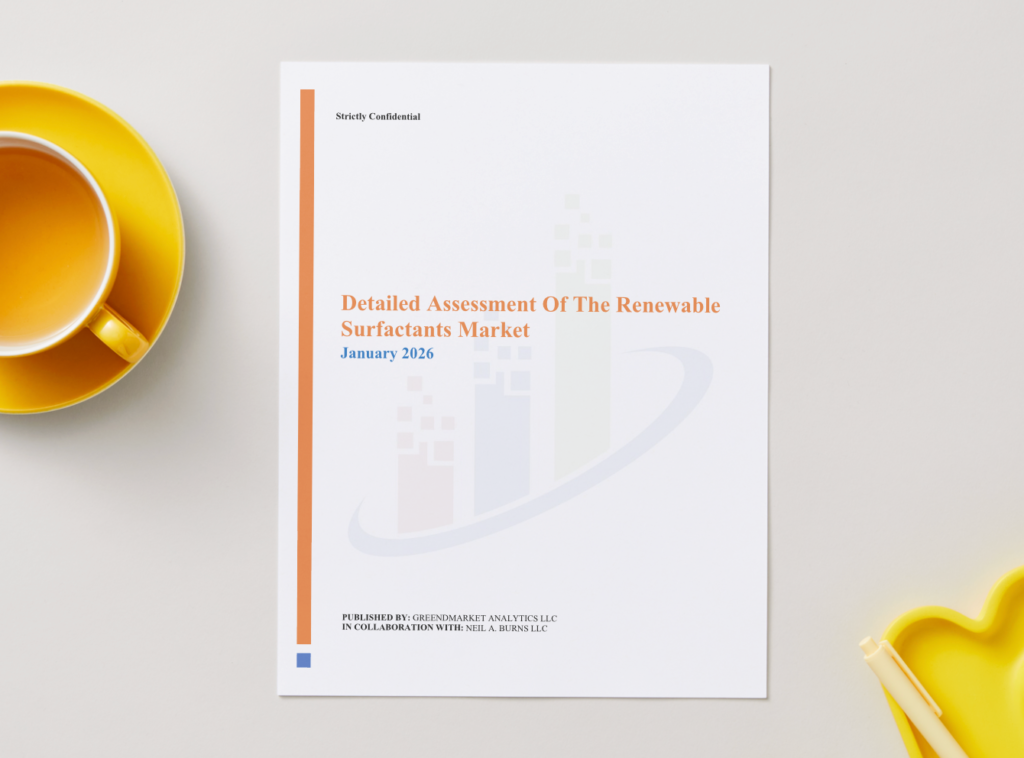
Green D Market Analytics’ new 243-page report, “Detailed Assessment of the Renewable Surfactants Market” is now available for purchase.
Contact us at admin@greendma.com for more information.
Green D Market Analytics can provide a specialized report highlighting the market for bio-based chemical intermediates and monomers. We provide our clients with confidential reports on the current industry landscape, including new and planned projects. Please contact us at info@greendma.com for more information about our customized client services, detailed market data, and special reports.
The GreenDMA Portal is unique in its ability to provide current data on the renewable chemicals market, including Capacity, Product Profiles, Market Players, Market Share, New Investments, New Plants, Critical Industry News, and analyses. Find out more at greendma.com/portal.