
The bio-based polymers market is not immune by the challenges plaguing the global plastics supply chain. The market is being tested by profitability, feedstock economics, downstream adoption and the ability of producers to scale without overbuilding ahead of demand.
Polybutylene succinate (PBS) is the clearest example. Mitsubishi Chemical’s withdrawal from the PTTMCC Biochem BioPBS™ business in Thailand removes one of the most visible commercial bio-based PBS platforms from the global market. Production ended in December 2025, with sales to continue only until remaining stocks are exhausted. PBS activities in China continues through a mix of bio-based and coal-based PBS projects and companies positioned around domestic packaging and agricultural film demand. China’s PBS growth is also fragmented and will depend heavily on actual operating rates, succinic acid/BDO economics and whether demand can absorb new capacity without repeating the oversupply issues seen in other biodegradable plastics.
Bio-based polyamides, especially in Europe, are seeing a different kind of restructuring. Lone Star Funds’ acquisition of RadiciGroup’s High Performance Polymers and Specialty Chemicals businesses, and of DOMO Engineered Materials (a division of DOMO Group), points to consolidation in the engineering polymers chain. Both businesses are known suppliers of bio-based PA610. Customers should expect tighter portfolio prioritization and stronger emphasis on high-margin applications.
Polylactic acid (PLA) is moving in the opposite direction from PBS where commercial capacity is still expanding. NatureWorks’ grand opening of its fully integrated Ingeo™ PLA facility in Nakhon Sawan, Thailand, is one of the most important global PLA events this year. Globally, PLA activity remains active, with TotalEnergies Corbion continuing to operate in Thailand, Futerro advancing its integrated PLA project in France, Emirates Biotech planning a large-scale PLA facility in the UAE, and China continuing to expand domestic capacity.
Polyethylene Furanoate (PEF) is now moving from technical promise toward early commercial reality. Avantium’s FDCA flagship plant in Delfzijl is progressing through its start-up phase while the company is actively in partnership mode for PEF sample programs and brand owner trials. Avantium’s recent life-cycle assessment communication also strengthens PEF’s positioning as a lower-carbon, high-barrier alternative for packaging. At the same time, China is becoming increasingly active in FDCA and PEF. (See last month’s Furanics update).
Green D Market Analytics’ GreenDMA Portal (subscription required) has mapped the fast-changing global landscape for several bio-based and biodegradable polymers plants and projects tracking capacity, location, project stage, and commercialization status with particular depth in China’s rapidly evolving biodegradable polymers sector. For producers, buyers, investors and strategy teams, GreenDMA Portal provides a practical intelligence base to separate real commercial supply from project noise and identify where the next phase of growth is taking shape within this industry.
For this month’s update, here are our latest curated news and analysis, some of which are featured in the GreenDMA Portal:
- ACETIC ACID: A chemical company will use low carbon methanol feedstock for acetic acid production. Bio-based acetic acid activities worldwide are on the rise this year.
- AROMATICS: European partnership announced for bio-based specialty aromatics in resins application. Introduction of a new bio-based phenolic compounds producer in Japan.
- DIACIDS: GDMA lists new bio-based succinic acid producers in China.
- DIOLS: Hyosung Chemical started bio-based BDO production in Vietnam. 1,3-Propanediol price on the rise worldwide.
- ETHYLENE: Bio-based ethylene finds its way in underwear garment.
- GLYCOLS: UPM acquires Avantium‘s bio-based glycols IP.
- FURANICS: A new participant enters the FDCA-PEF value chain in China.
- METHANOL: A new biomass-based methanol project in India was announced.
- OLEFINS: Ongoing restructuring within the mass balance and circular-derived olefins production in Europe.
- PHA and PLA: TotalEnergies Corbion launched a washable, bio-based kitchen towel using PLA and PHA blend with a South Korean partner. NatureWorks starts its new PLA operation in Thailand. A Chinese company launched cutting boards made from PHA. CJ Biomaterials, Inc. launched compostable food serviceware derived from PHA.
- POLYOLS: Production starts for industrial-scale recycled polyol plant in Europe.
SURFACTANT UPDATES: Green D Market Analytics discovered another glycolipid producer in China. Dispersa is scaling up its biosurfactant production in Canada and also received US regulatory approval for its flagship surfactant blend. Two start-up companies enter the bio-based emulsifiers market.
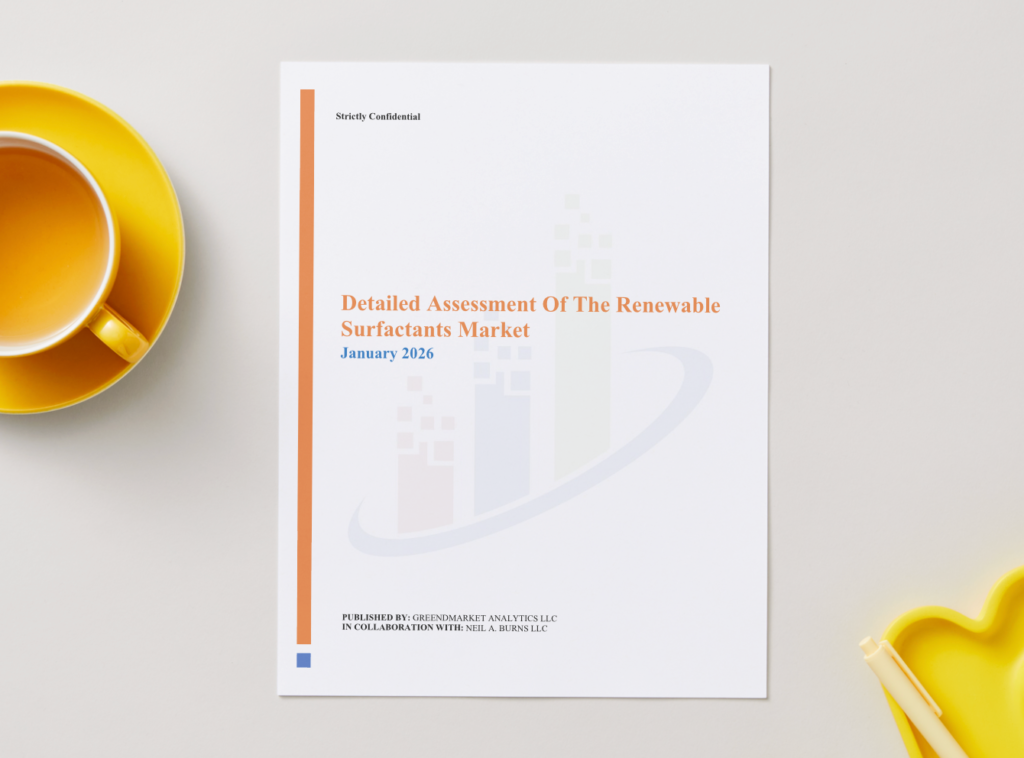
Green D Market Analytics’ new 243-page report, “Detailed Assessment of the Renewable Surfactants Market” is now available for purchase.
Contact us at admin@greendma.com for more information.
The GreenDMA Portal is unique in its ability to provide current data on the renewable chemicals market, including Capacity, Product Profiles, Market Players, Market Share, New Investments, New Plants, Critical Industry News, and analyses. Find out more at greendma.com/portal.
Green D Market Analytics can provide a specialized report highlighting the market for bio-based chemical intermediates and monomers. We provide our clients with confidential reports on the current industry landscape, including new and planned projects. Please contact us at info@greendma.com for more information about our customized client services, detailed market data, and special reports.