
Europe’s chemical industry is facing an industrial reckoning. High energy costs, global overcapacity, weakening competitiveness and growing import competition have accelerated the closure of chemical production assets across the region. According to the European Chemical Industry Council (Cefic), cumulative announced chemical plant closures reached 37 million tons of annual capacity between 2022 and early 2026, equivalent to approximately 9% of European chemical production capacity.
chemXplore‘s monitoring of 16 chemical clusters in Northwest Europe identifies 51 closure records since 2023, alongside substantial new industrial investment activity. These figures highlight a troubling contradiction: Europe is seeking to decarbonize its chemical industry while simultaneously losing parts of the manufacturing infrastructure needed to sustain its downstream industries. Could the accelerating development of biomanufacturing offer an opportunity to rebuild some of this lost industrial capacity?
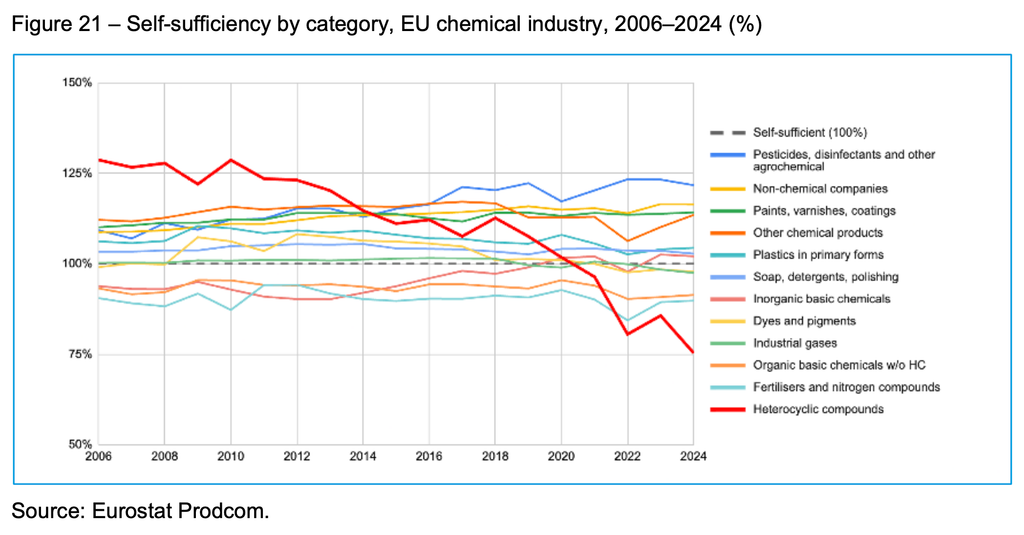
A September 2026 study by CE Delft, Market Analysis of the European Chemical Industry: Current Status and Review of Scenarios, offers a more nuanced picture of Europe’s chemical competitiveness. Despite the closures, the EU chemical industry maintained a €37 billion trade surplus in 2025 (approximately USD $43 billion) and listed European chemical companies recorded average operating profit margins of 10.4% during 2016–2025. The report also found that these companies distributed €191 billion (approximately USD $222 billion) to shareholders over the same period, while investment rates declined. CE Delft envisions a potentially smaller, more decentralized and circular European chemical industry, combining electrification, recycled carbon, renewable feedstocks and selective retention of strategically important conventional production. The challenge is determining which chemical value chains Europe should preserve, which it can competitively transform, and where new domestic manufacturing capabilities are most urgently needed.
Several emerging European biomanufacturing projects demonstrate what this industrial transition could look like. UPM’s Leuna biorefinery in Germany, with an integrated nameplate capacity of 220,000 tpa of wood-derived biochemicals, began commercial production of industrial sugars in late 2025 and subsequently reported lignin production and sales; commercial glycol output remains a separate start-up milestone requiring confirmation. AFYREN NEOXY in France has established a 16,000 tpa fermentation-based organic acids facility, although production remains in the commercial ramp-up phase. Avantium’s 5,000 tpa FDCA plant in Delfzijl, the Netherlands, is progressing through commissioning and initial production, potentially establishing a European manufacturing base for a renewable polyester building block. Verbio’s Bitterfeld facility in Germany represents an important renewable-feedstock investment, targeting up to 60,000 tpa of biobased specialty chemicals, including 1-decene and 9-DAME.
These facilities cannot replace the enormous volumes of conventional petrochemicals being lost, but they illustrate Europe’s ability to develop differentiated renewable chemical platforms with applications in polymers, coatings, adhesives, surfactants and other industrial materials.
Europe has agricultural residues, forestry resources, industrial biogenic waste streams, fermentation expertise, chemical engineering capabilities and established downstream customers. Integrating these resources into existing chemical clusters could support domestic production of organic acids, glycols, renewable surfactant intermediates, specialty monomers, biopolymers and renewable aromatics. Existing infrastructure—including utilities, logistics, storage, pipelines and industrial services—could reduce the capital requirements for new manufacturing investments. Circular feedstocks, such as recycled plastics and recovered carbon, can complement biomass where technically and economically appropriate. However, biomanufacturing is not a universal substitute for conventional petrochemicals. Feedstock availability, competing demand from biofuels and sustainable aviation fuels, conversion yields, product qualification and manufacturing costs will determine which technologies can scale. The objective should be strategic chemical self-sufficiency not a blanket replacement of fossil-based capacity.
Achieving this transition will require a different approach to industrial policy and project financing. Europe needs more than demonstration funding and ambitious biomanufacturing roadmaps. Commercial facilities require predictable demand, competitive electricity and utility costs, reliable sustainable feedstock supplies and long-term customer commitments. Contracts for Difference, targeted capital guarantees, technology performance guarantees and bankable offtake agreements could help bridge the gap between successful demonstration and profitable commercial production. Public procurement, renewable-carbon product requirements and credible traceability systems could also stimulate demand without permanently insulating producers from competition. Crucially, public support should prioritize projects with realistic economics, strategic downstream applications and credible scale-up pathways. Europe cannot afford to replace one set of structurally uncompetitive assets with another simply because the new feedstock is renewable.
CE Delft’s analysis points toward a potentially smaller, more decentralized and increasingly circular European chemical industry, combining recycled carbon, renewable feedstocks, electrification and selective retention of strategically important conventional production. Biomanufacturing can contribute to this transformation, particularly where it supplies essential intermediates, strengthens regional supply chains and creates differentiated chemical products. But the industry must move beyond counting announced projects and nameplate capacities toward measuring actual production, utilization, investment returns and customer adoption. Europe’s chemical future will not be secured by preserving every plant of the past. It will depend on building the right plants for the future. The question is whether policymakers, chemical producers, investors and downstream customers can coordinate quickly enough to make that transition commercially viable.
Green D Market Analytics can support companies tracking bio-based chemicals and materials commercial developments through our custom and multi-client market reports, and our GreenDMA database portal. Coverage includes affected chemical value chains, supplier activities, renewable material developments, technology scale-up, pricing signals, capacity build-out and commercial readiness. Which policies are changing demand? Which materials and chemicals face risk? Which technologies and companies are scaling, and where are new supply chain opportunities forming?
Green D Market Analytics can help provide answers to these questions. The GreenDMA Portal also provides ongoing news and market updates for products and companies that need regular tracking rather than one-off search.
For this month’s update, here are our latest curated news and analysis, some of which are featured in the GreenDMA Portal:
- ACETYLS: Bio-based acetic acid moves toward commercial scale and downstream adoption.
- AROMATICS: BioBTX to build circular aromatics plant.
- DIACIDS: Sebacic acid substitution accelerates with fermentation-derived alternative. Bio-based adipic acid scale-up is back.
- DIAMINES: Cathay Biotech’s bio-PDA output remains limited.
- DIOLS: Global bio-BDO capacity: What’s operating in 2026. China’s bio-PDO expansion advances. Meijingrong’s bio-PDO and PTT future in limbo. Bio-PTMEG and bio-spandex scale up in Asia.
- FURANICS: Sugar Energy, Leaf Bio provide furanics commercialization updates. Avantium sharpens FDCA/PEF focus. PEF expands into performance textiles. FDCA capacity is rising fast but actual production still lags.
- HYDROCARBONS: EU biomethane boom fuels new growth for bio-methanol. Cosmo Oil to Begin Utilizing Naphtha Co-Produced During SAF Production.
- PINE CHEMICALS: Symrise signs agreement to divest its terpene ingredients business.
- PHA and PLA: PHA finds its footing as new applications put scale-up to the test. Bioextrax advances PHBV project in Western Asia. Mango Materials target lower-cost PHA production from waste methane.
- PBS and PBAT: Kingfa scales integrated bio-succinic acid and bio-BDO platform for PBAT and PBS production.
Green D Market Analytics’ new 243-page report, “Detailed Assessment of the Renewable Surfactants Market” is now available for purchase.
Contact us at admin@greendma.com for more information.
Green D Market Analytics can provide a specialized report highlighting the market for bio-based chemical intermediates and monomers. We provide our clients with confidential reports on the current industry landscape, including new and planned projects. Please contact us at info@greendma.com for more information about our customized client services, detailed market data, and special reports.
The GreenDMA Portal is unique in its ability to provide current data on the renewable chemicals market, including Capacity, Product Profiles, Market Players, Market Share, New Investments, New Plants, Critical Industry News, and analyses. Find out more at greendma.com/portal.

Leave a Reply